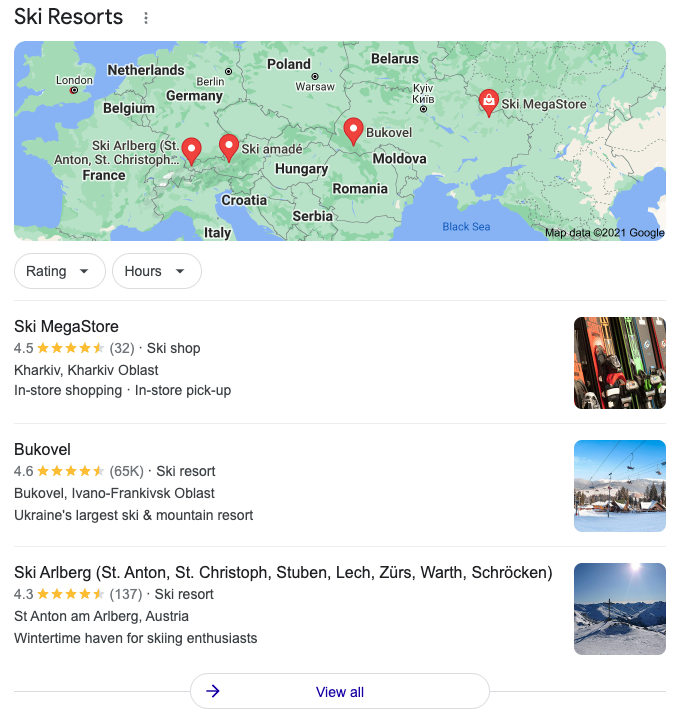
Local SEO strategies help a business show up when people nearby search for what it sells: in the map pack, in Google Maps and in the ordinary results underneath. For a shop, clinic, restaurant or service business, those searches are often the ones closest to a sale, because the person searching usually wants to visit or call soon.
Google says local results depend mainly on three things: relevance (how well your business matches the search), distance (how far you are from the searcher) and prominence (how well known your business is). You cannot change distance, but everything below works on relevance and prominence.
Who local SEO strategies are for
Local SEO applies to any business that serves customers in a specific area. That includes businesses with a physical location, service-area businesses that travel to customers, and companies with several branches, where each location is treated as its own local business.
1. Set up and complete your Google Business Profile
Your Google Business Profile (formerly Google My Business) is the foundation of every local SEO strategy. Without a verified profile, you will not appear in the map pack or in Google Maps for most searches.
Fill in every relevant field:
- business name, exactly as it appears on your signage;
- address or service area, phone number and website;
- opening hours, including holiday hours;
- primary and secondary categories, which strongly affect which searches you appear for;
- products, services and attributes;
- real photos of the premises, team and work.
Keep it active afterwards. Update hours, add photos, answer questions and publish posts about offers or events. Google’s own tips to improve your local ranking are a good checklist.
2. Keep your name, address and phone number consistent
Search engines compare your business details across the web. If your name, address and phone number (often called NAP) differ between your website, your profile and directories, that creates doubt about which version is correct.
So list your business on the main platforms, such as Bing Places, Apple Business Connect, Yelp, Facebook and the directories that matter in your industry and country. Use exactly the same details everywhere, and update all of them if you move or change your number.
3. Build location pages on your website
Your Business Profile helps you rank in the map pack. Your website helps you rank in the organic results below it, and it supports the profile as well.
For each location or main service area, create a page with genuinely local content: the address, opening hours, a map, local photos, the services offered there, and details such as parking or nearby landmarks. Avoid near-identical pages where only the city name changes, because they add little value and rarely rank.
Adding LocalBusiness structured data to these pages also helps search engines read your details correctly.
4. Use local keywords where they fit
People search in different ways: “florist near me”, “emergency plumber Leeds”, “vegan bakery in the city centre”. Research the terms customers in your area actually use, and include them naturally in page titles, headings, meta descriptions and page copy.
The goal is to make it clear what you do and where you do it. Repeating the city name in every sentence will not help.
5. Earn reviews and respond to them
Reviews affect both your ranking and whether people choose you. Google notes that more reviews and positive ratings can help local ranking.
Ask satisfied customers for a review at the right moment, for example after a completed job or in the email receipt, and make it easy with a direct link. However, do not offer discounts, gifts or payment in exchange. Google’s content policy for Maps prohibits incentivised reviews, and breaking it can lead to reviews being removed.
Reply to reviews too, both positive and negative. Future customers read your replies, so thank people briefly and, for complaints, acknowledge the problem and offer a way to resolve it offline. For more on handling criticism, see our guide to dealing with negative brand mentions.
6. Earn local links and mentions
Prominence also comes from the wider web. Links and mentions from local news sites, community organisations, event pages, suppliers and local business associations all help.
Sponsoring a local event, contributing expert comments to local media or partnering with nearby businesses are practical ways to earn them. Our article on the rules of link building explains which links are worth pursuing.
7. Support local SEO with local advertising
Paid campaigns are not part of SEO, but they work well alongside it, especially while organic visibility is still growing. Local search ads and location-targeted social campaigns let you reach people in a defined radius around your business.
Track the results separately, so you know which calls and visits come from organic search and which come from ads. For paid options, see our Google Ads for local services.
How to measure your local SEO strategies
Watch the performance report in your Business Profile for searches, calls, direction requests and website clicks. In addition, track rankings in the map pack for your main terms from several points in your area, since results change with the searcher’s location. Finally, look at organic traffic and conversions on your location pages in Google Analytics and Search Console.
If you would like a team to handle this for you, our local SEO services cover profile optimisation, citations, location pages and reporting.
 202|
 0